-
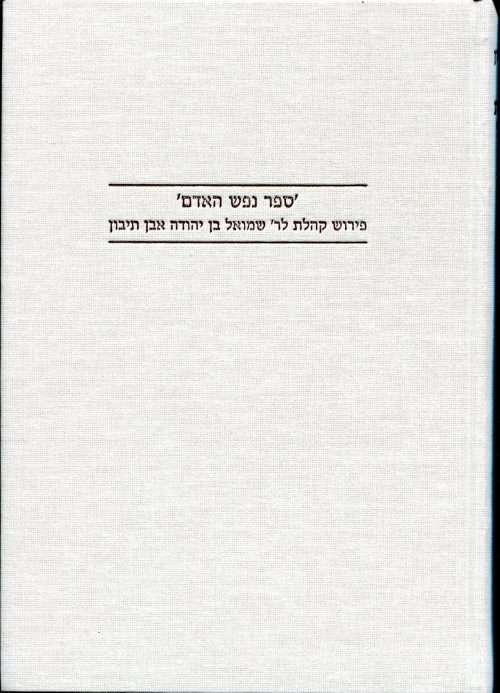
-25%Out of stockSamuel b. Judah ibn Tibbon (c. 1165-1232) is most famous for his translation of Maimonides’ Guide of the Perplexed into Hebrew. He translated other writings as well, and produced original works of philosophy and biblical exegesis. This book makes available for the first time ever Ibn Tibbon’s Perush Qohelet, a sprawling adaptation of Maimonides’ method of exegesis to the complete verse-by-verse explication of a biblical book. The edition is presented with full annotation -- identifying Ibn Tibbon’s sources and explaining his ideas and terminology -- and analytical introduction, which presents the life and writings of the author, describes the commentary itself in detail, explains the method and philosophy of the commentary, and charts its historical influence. In later medieval Jewish thought, few figures were unaffected by this foundational work of Maimonideanism.
-
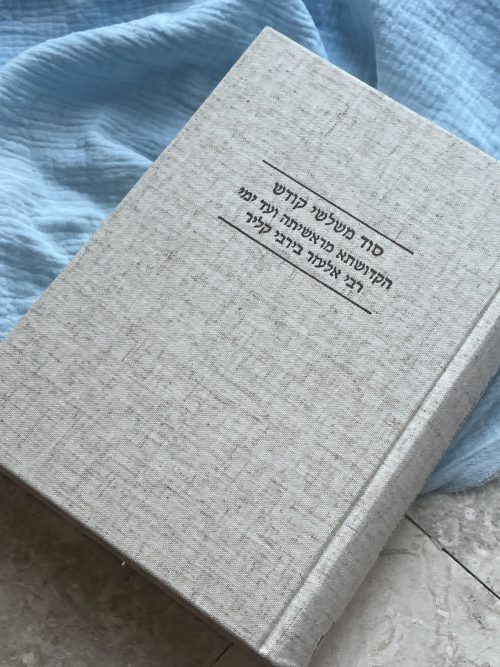
-25%A qedushta is a series of piyyutim for the ‘Amida prayer, which is expanded in honor of the recitation of the Qedusha, and includes many complex components. Its origins are in the Land of Israel, in the fourth or fifth century. We first see it as a constructed composition with set, complex, rules in the work of the poet Yannai, who lived in the mid-sixth century, the teacher of Rabbi El‛azar berabbi Qillir (who is known popularly as “the Qallir”). The qedushta, as it appears in the hundreds of compositions by Yannai and his followers, conceals many secrets: mysterious strings of biblical verses accompany its first components; a fixed biblical verse concludes the third component, followed by the strange words “El Na”; then comes a fourth component, whose structure is free, and always concludes, for some reason, with the word “Qadosh”; the fifth component in Yannai’s compositions is the ‘asiriya, a poem constructed of a truncated alphabetical acrostic from only aleph to yud, followed by a prayer beginning “El Na Le‘olam Tu‘aratz” – and it is unclear why this prayer appears here; then there is a group of poems called rahitim, which are written, for some reason, in unique, stereotypical structures. These are only a fraction of the various strange features of the qedushta’ot of Yannai and the other poets. The discussions in the book are dedicated to suggesting solutions to all these questions, and to others, and involve uncovering fragments of qedushta’ot that preceded Yannai; by examining these texts, they excavate the literary remains to construct a model of the gradual development of the qedushta over time, from its origins until it reached its complex structure in the days of Yannai and Rabbi El‛azar berabbi Qillir. The first section of the book, which is the largest, is devoted to this development of the qedushta, in all its elements, including those that follow the recitation of Qedusha. Naturally, this section deals with the piyyutim mostly from a structural point of view, for only such an analysis can enable a comprehensive look at the development of the genre. However, as a base for these structural analyses, this section contains the texts of many piyyutim, mostly pre-classical (from the period before Yannai, when the poets did not yet use rhyme). Alongside them are printed classical rhyming piyyutim, too, from the period of Yannai and his colleagues, and, in a few instances, even piyyutim from later periods. The second section of the book focuses on one single poet: Rabbi El‛azar berabbi Qillir, the most prolific of the classical poets in the Land of Israel, whose poems reached Europe, and some of them are recited in Ashkenazic and Italian synagogues through today. The qedushta’ot of Rabbi El‛azar berabbi Qillir are varied in both their structures and their styles, much more than those of Yannai; this section is devoted to an analysis of these compositions, and an attempt to map out which ones are earlier and which later. On the basis of precise structural analysis, the section builds a higher level of analysis – stylistic; and thus, we see the picture of the great poet’s literary journey. It becomes clear that when he was started out, he was heavily influenced by the work of Yannai, and slowly he created new ways for himself: at first he went in the direction of obscurity and difficulty, which he gradually made more and more obscure; but then, in a later, more mature phase, he turned to pure lyrical song, which today’s reader, too, will find sweet. The third section leaves aside the structural analyses, and suggests directions for further research. This section is short, and contains only first steps towards new directions in piyyut analysis. It focuses primarily on content, and ways that the qedushta’ot are organized, but it moves on to questions of how the qedushta is constructed as a complete composition, and points out various difficulties that the poets needed to overcome, and analyzes at length their literary solutions to these problems. Yannai stands at the center of the discussion in this section, but there are also notes about other poets. Most of the suggested directions for further research are new, and we hope that they will lead to further productive scholarship, and make it possible to study the piyyutim from angles that have hitherto been less examined. Throughout the book, phenomena are demonstrated by means of the texts of piyyutim. More than 250 piyyutim are printed in the book, of which about 130 are being printed for the first time. Most of these piyyutim are from the earlier periods of piyyut, and their publication in this volume reveals the full contribution of these layers of the genre to our understanding of the history of the qedushta. Even the piyyutim that have already been printed elsewhere often were published in out-of-the-way publications, some of them with no vowels or commentary. It goes without saying that for this volume, these texts were all printed anew straight from the manuscripts. When pieces from Yannai’s work are cited to exemplify some point, an attempt has been made, inasmuch as possible, to use pieces that have not been included in the existing publications of his work, and thus the volume contributes a great amount of new material to the corpus of Yannai’s piyyutim. The volume as a whole is based on examination of hundreds of manuscripts, mostly from the Cairo Geniza, and these provide a wide, firm textual basis to the analysis. The book is intended first and foremost for scholars, but it will also enable people interested in piyyut and its history from outside the world of academia to gain exposure to a great corpus of early piyyutim, among which are several stunningly beautiful gems, which are being published here for the first time.
-
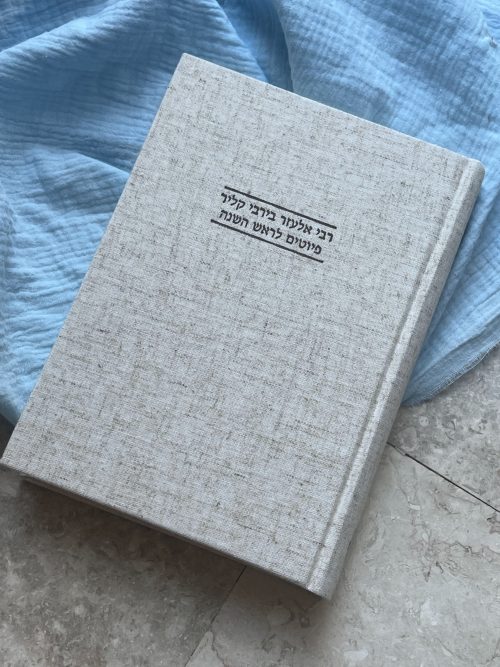
-25%This book is devoted to the compositions that were written for Rosh Hashana by the illustrious poet R. El‘azar berabbi Qillir, who was active in the Land of Israel at the beginning of the seventh century. The piyyutim for Rosh Hashana are many and varied, and they adorn all of the special prayers for the festival. A number of these piyyutim are known and recited to this day in Ashkenazi congregations, while others are published here for the first time. This edition has been prepared on the basis of close to 400 manuscripts, and all of the variant readings have been given in the margins. An extensive commentary aids the reader in understanding the difficult idiom of the payyetan, identifying the many scriptural and midrashic sources that are woven into the piyyutim, and following the development of their themes.
-
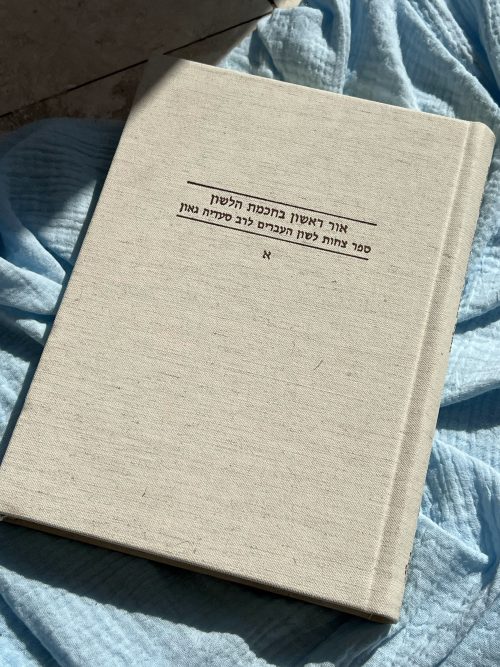
-25%The Book of Elegance of the Hebrew Language is Saadia Gaon's (892-942) Judeo-Arabic work on Hebrew linguistics. It is the first Hebrew grammar book, describing for the first time the Hebrew language, its letters, the vowels and the shewa, the dageshs, the influence of the gutturals, the inflections etc. The edition comprises of two volumes: the first is the introduction describing the work and its date, its structure and relationship to other works, with an analysis of the linguistic theory and the various grammatical issues as well as a comprehensive vocabulary of terminology, a complete survey of the chapters, a description of the manuscripts and method of editing and finally an extensive bibliography. The second volume hold the original Arabic text with a Hebrew translation by the editor, and apparatus of various readings and numerous commenting notes and indices.
-
-25%Out of stock55 Geniza Documents.
-
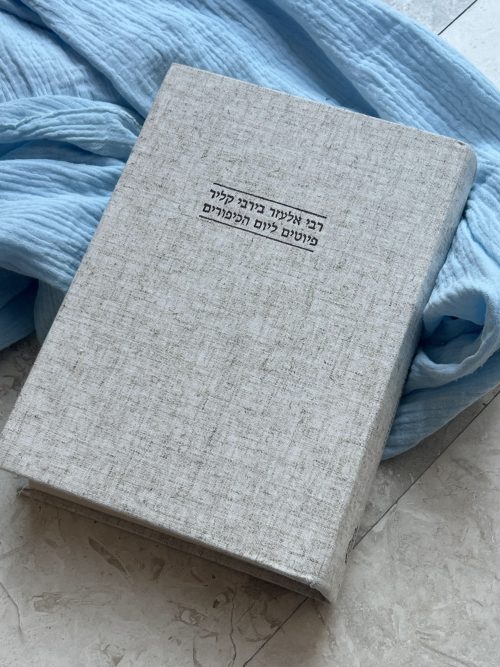
-25%Rabbi El'azar Berabbi Qillir (commonly known as "HaQallir") was the most famous and productive of the Hebrew poets during the peak era of early Hebrew piyyut (liturgical poetry) between the sixth and eighth centuries AD. Of the thousands of poems he penned, some were preserved in the Asheknazi, French and Italian mahzorim (prayer books) for the High Holy Days, and a few of them are recited in synagogues to this day. Notable examples of such from among his Yom Kippur poems are the poems "Praise God: Almighty, King of His universe" ("אמרו לאלהים: אל מלך בעולמו") and "The work of our God! He is mighty amidst His [Divine] assembly" ("מעשה אלהינו אדיר בוויעודו"); these two poems are still recited even in those Ashkenazi communities which skip most of the other poetic segments recorded in the mahzorim for the High Holy Days. The Cairo Geniza findings indicate that the European mahzorim preserve only a handful of Qillir's works for Yom Kippur. In fact, he adorned each of the day's prayers with several poetic compositions, most especially with qedushta'ot, arrays of poems intended to be recited as part of the amidah ("the standing prayer"), anticipating the recitation of the qedusha. Time and again, Qillir penned new compositions intended to replace the previous ones. Alongside his qedushta'ot for musaf and for ne'ila which are found in the Ashkenazi mahzorim, the Genizah fragments reveal additional Qillirian qedushta'ot for these same prayers, as well as poems for ma'ariv, shaharit and minha. In addition, it turns out that the qedushta'ot in the Asheknazi mahzorim were corrupted; some of the original Qillirian segments were omitted, and later non-Qillirian segments were interpolated at various places. The present edition comprises a collection of all of the surviving poems authored by Rabbi El'azar BeRabbi Qillir for all of the Yom Kippur prayers. This edition attempts to restore the full compositions as per the textual witnesses from the Cairo Genizah, with the aid of the material from the European mahzorim. The poems are printed with full vocalization, apparatus criticus, and extensive running commentary. The restoration of the qedushta'ot incurred many questions, discussed in detail in the introduction. The introduction includes a comprehensive exploration of the multiple segments contained in each of Qillir’s compositions, including a discussion of the exact purpose of each segment and a justification of its attribution to Qillir. The introduction also describes the prosodic structures of Qillir’s poems for Yom Kippur, their poetic characteristics, their unique language and stylistics, and their thematic content. An additional section focuses upon rare midrashic traditions reflected within the poems, as well as rare Jewish legal traditions and customs. Many of the poetic segments contained herein have never before appeared in a proper scientific edition, including spectacular works such as silluq (the segment immediately prior to the qedusha) for musaf; a series of rahitim (poems prior to the silluq) expounding upon the verses describing the High Priest's work on Yom Kippur, and another series of over twenty rahitim praising God, which are without a doubt among Rabbi El'azar BeRabbi Qillir's finest works; and sidre pesukim (poetic compositions which expound upon the Biblical verses which were recited during that era within the amidah itself). In his compositions for the minha prayer, Qillir often dedicates the rahitim to the story of Elijah the Prophet on Mount Carmel; several of these describe the miracle of the fire coming down from the sky, and primarily Elijah's prayer – which in effect becomes the poet's prayer for his audience. Perusal of the poems reveals quite a few surprises, from original linguistic feats to previously unknown Midrash traditions, and above all, uplifting segments of poetry. Several of these are presented in the introduction, but the edition is the crux of the book, and through it readers will be able to delve deep into Qillir's Yom Kippur poems, to learn from the Torah contained within them, and to delight in their beauty.
-
-25%In the past, prayers in the synagogue were adorned with many liturgical poems, piyyuṭim, in all the various Jewish communities, both on the major festivals and on many Sabbaths over the course of the year. Manuscripts preserve thousands of piyyuṭim, only some of which are familiar today, and some of which have never been published until our generation. This book collects more than two hundred piyyuṭim, which the Jews of Ashkenaz (German-speaking lands) and Northern France used to recite on wedding Sabbaths and Sabbaths on which circumcisions occurred. Dozens of poets wrote piyyuṭim for these festive occasions. Most of the piyyuṭim were written by German or French poets (between the eleventh and fourteenth centuries), but some of them were written by poets in the Land of Israel, Italy, or Spain. Some of the compositions were written in honor of lifecycle celebrations occurring in the families of the poets themselves. Aside from the major popular genres of Ashkenazic piyyuṭ (yoẓer, ofan, and zulat, in the blessings surrounding the morning Shema), the corpus in this volume also contains representatives of many unusual genres of piyyuṭ; this prominently demonstrates that on Sabbaths of family celebrations, the poets of Ashkenaz and Northern France wanted to include piyyuṭim in many different positions in the liturgy, more varied than usual. Especially prominent is the large unit of piyyuṭim that were recited surrounding the bridegroom’s ‘aliyya to the Torah: reshut (“invitation”) poems for the bridegroom and his groomsmen to go up for their ‘aliyyot, songs in honor of the bridegroom after his ‘aliyya, poems surrounding the reading of Ve’avraham Zaqen (a passage from the Torah that is read in honor of the bridegroom — today only in Sephardic synagogues, but in the past also in Ashkenazic), and Mi Shebberakh poets blessing the bridegroom after his ‘aliyya. Some of the poems are in Aramaic. The book includes also piyyuṭim that were recited (not specifically on the Sabbath) at the actual wedding and circumcision rituals, and piyyuṭim designated for the Grace After Meals of the festive meals in honor of the wedding and circumcision. The Ashkenazic poets were extremely learned, and they included large amounts of material from the lore (aggada) of the Talmud and Midrash. The late Prof. Jonah Fraenkel was the one that gathered the piyyuṭim for the Sabbaths of the year recited in the Ashkenazic and Northern French communities, as a continuation of his series of Ashkenazic maḥzorim for the Three Festivals and those for the High Holidays edited by Dr. Daniel Goldschmidt. This volume of piyyuṭim for wedding and circumcision Sabbaths is the first in a series whose purpose is to publish all piyyuṭim for all Sabbaths that were recited in the lands of Ashkenaz and Northern France. Dr. Gabriel Wasseman, a scholar of piyyuṭ, completed Fraenkel’s work on this volume, indicating textual variants from many dozens of manuscripts, and writing a detailed commentary on the piyyuṭim. He also wrote a long introduction to the volume, which, among other things, offers a birds’-eye view of all the piyyuṭim, organized into their specific genres, and traces the development of the customs of reciting these piyyuṭim in the various communities over the course of centuries. Avraham Fraenkel added chapters to the introduction, which present a description of the customs of weddings and of circumcisions in Ashkenaz and Northern France, on the basis of books of minhagim (“customs”) and prayerbooks from the Ashkenazic and Northern French communities.
-
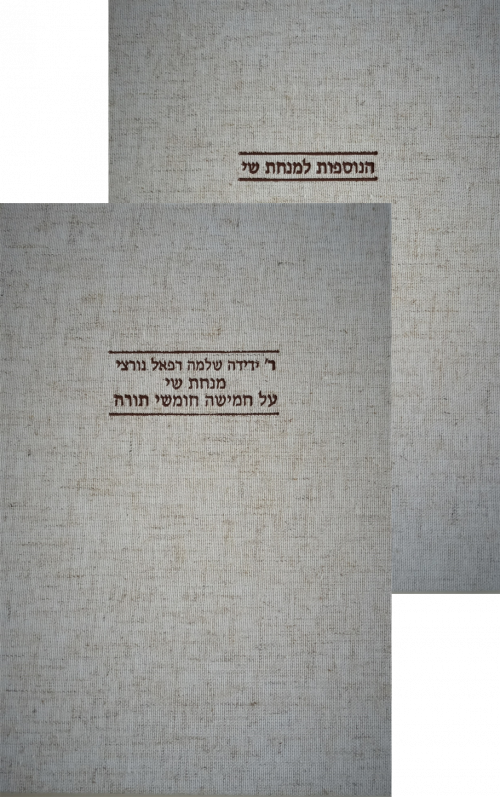
-25%Minhat Shai, by the seventeenth-century scholar Yedidyah Shlomo Norzi, deals with the forms, vocalization, and Masoretic interpretation of biblical terms, in the order of their appearance in the Bible. The aim of this work is to analyze words with respect to their orthography, vocalization, and cantillation, and to assess their proper forms. The work was first printed in Mantua in the middle of the eighteenth century; it has since been reprinted in various places and always as part of editions of the Pentateuch or other sections of the Bible. The version in use today accords with the text as printed in Mikra’ot Gedolot (Vilna/Warsaw editions), where the relevant sections were appended following each biblical book. The Addenda to Minhat Shai complete the publication of Minhat Shai on the Torah.
-
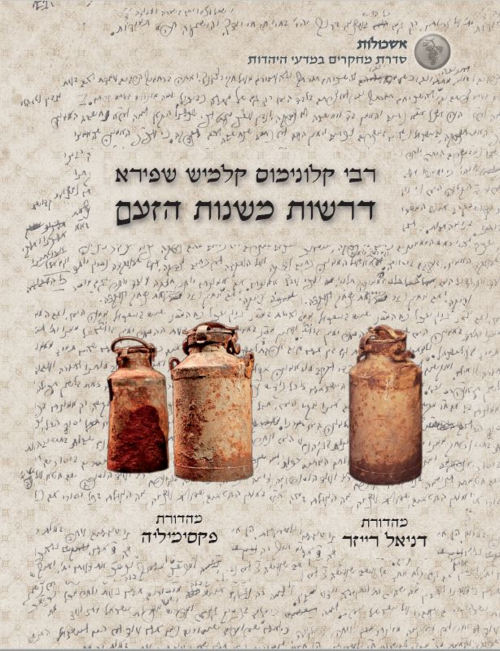
-25%Scholarly and Facsimile Edition This book presents the sermons of Rabbi Kalonymus Kalmish Shapira, The Piaseczno Rebbe, which were delivered during the Holocaust years in the Warsaw Ghetto. The second volume is a facsimile edition, with the original manuscript on one side and the detailed line-by-line presentation of the text as the Rebbe corrected it. The second volume includes the words and passages that were deleted and is printed in 4 different colors which follow the proofs and changes that the Rebbe made in the text.
-
-25%Meir of Rothenburg (c. 1215 – 2 May 1293) was a German Rabbi and poet, a major author of the tosafot on Rashi's commentary on the Talmud. He is also known as Meir ben Baruch, the Maharam of Rothenburg. His responsa are of great importance to advanced students of the Talmud, as well as to students of Jewish life and customs of the 13th Century.
-
-25%Rabbi El'azar Berabbi Qillir (commonly known as "HaQallir") was the most famous and productive of the Hebrew poets during the peak era of early Hebrew piyyut (liturgical poetry) between the sixth and eighth centuries AD. Of the thousands of poems he penned, some were preserved in the Asheknazi, French and Italian mahzorim (prayer books) for the High Holy Days, and a few of them are recited in synagogues to this day. The Cairo Geniza findings indicate that the European mahzorim preserve only a handful of Qillir's works. This edition attempts to restore the full compositions as per the textual witnesses from the Cairo Genizah, with the aid of the material from the European mahzorim. The poems are printed with full vocalization, apparatus criticus, and extensive running commentary. Perusal of the poems reveals quite a few surprises, from original linguistic feats to previously unknown Midrash traditions, and above all, uplifting segments of poetry. Several of these are presented in the introduction, but the edition is the crux of the book, and through it readers will be able to delve deep into Qillir's poems, to learn from the Torah contained within them, and to delight in their beauty.